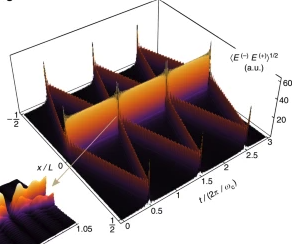
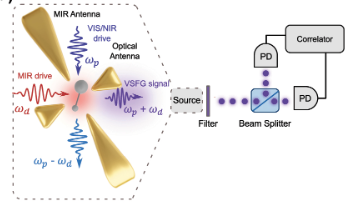
Abstract Sum-frequency generation (SFG) enables the coherent upconversion of electromagnetic signals and plays a significant role in mid-infrared vibrational spectroscopy for molecular analysis. Recent research indicates that plasmonic nanocavities, which confine light to extremely small volumes, can facilitate the detection of vibrational SFG signals from individual molecules by leveraging surface-enhanced Raman scattering combined with mid-infrared laser excitation. In this article, we compute the degree of second order coherence (g(2)(0)) of the upconverted mid-infrared field under realistic parameters and accounting for the anharmonic potential that characterizes vibrational modes of individual molecules. On the one hand, we delineate the regime in which the device should operate in order to preserve the second-order coherence of the mid-infrared source, as required in quantum applications. On the other hand, we show that an anharmonic molecular potential can lead to antibunching of the upconverted photons under coherent, Poisson-distributed mid-infrared and visible drives. Our results therefore open a path toward bright and tunable source of indistinguishable single photons by leveraging “vibrational blockade” in a resonantly and parametrically driven molecule, without the need for strong light-matter coupling.
npj Quantum Inf
Entanglement of photonic modes from a continuously driven two-level system
Jiaying Yang, Ingrid Strandberg, Alejandro Vivas-Viaña, Akshay Gaikwad, Claudia Castillo-Moreno, Anton Frisk Kockum, Muhammad Asad Ullah, Carlos Sánchez Muñoz, Axel Martin Eriksson, and Simone Gasparinetti
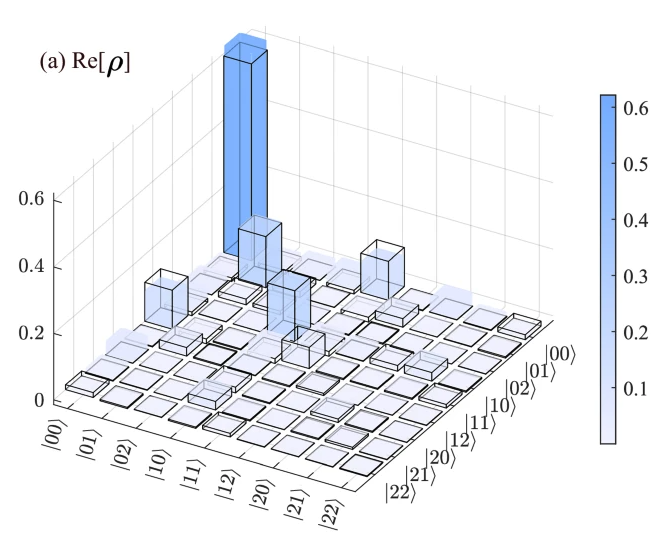
Abstract The ability to generate entangled states of light is a key primitive for quantum communication and distributed quantum computation. Continuously driven sources, including those based on spontaneous parametric downconversion, are usually probabilistic, whereas deterministic sources require accurate timing of the control fields. Here, we experimentally generate entangled photonic modes by continuously exciting a quantum emitter - a superconducting qubit - with a coherent drive, taking advantage of mode matching in the time and frequency domain. Using joint quantum state tomography and logarithmic negativity, we show that entanglement is generated between modes extracted from the two sidebands of the resonance fluorescence spectrum. Because the entangled photonic modes are perfectly orthogonal, they can be transferred into distinct quantum memories. Our approach can be utilized to distribute entanglement at a high rate in various physical platforms, with applications in waveguide quantum electrodynamics, distributed quantum computing, and quantum networks.
2024
Physics Reports
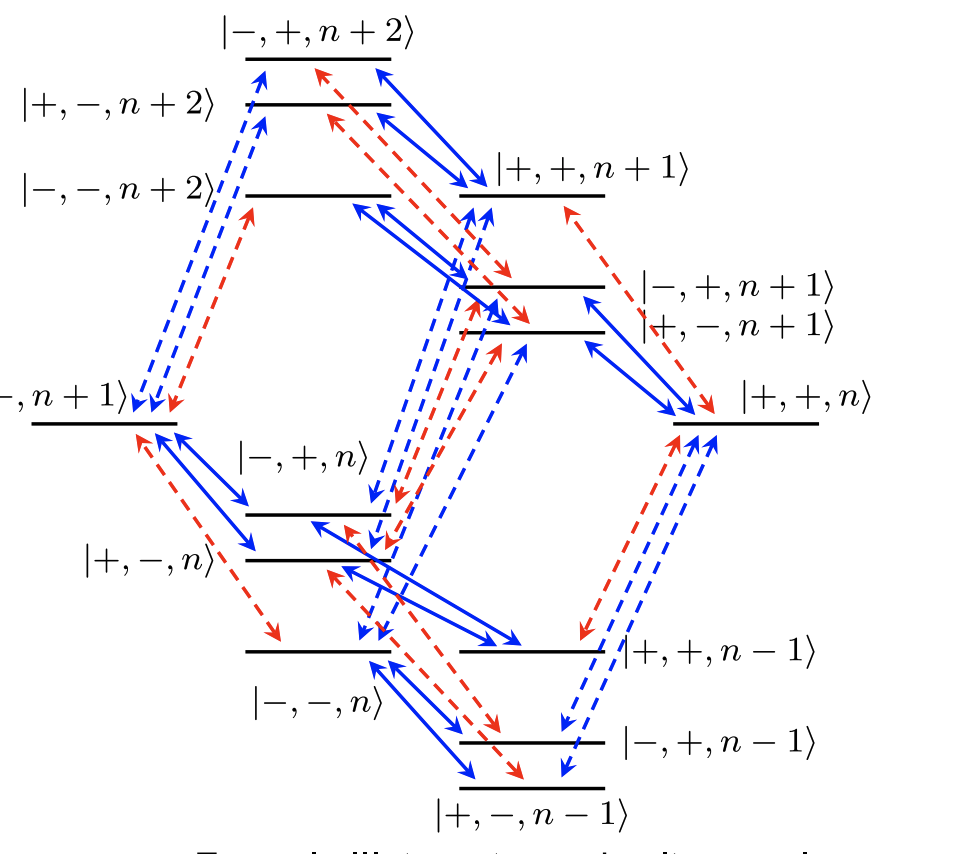
Quantum amplification and simulation of strong and ultrastrong coupling of light and matter
Wei Qin, Anton Frisk Kockum, Carlos Sánchez Muñoz, Adam Miranowicz, and Franco Nori
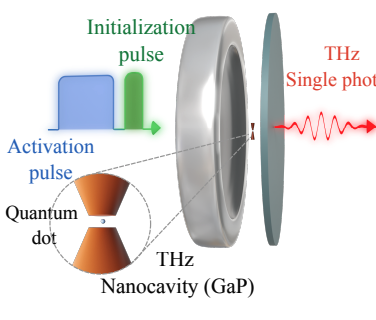
We present a proposal for a tunable source of single photons operating in the terahertz (THz) regime. This scheme transforms incident visible photons into quantum THz radiation by driving a single polar quantum emitter with an optical laser, with its permanent dipole enabling dressed THz transitions enhanced by the resonant coupling to a cavity. This mechanism offers optical tunability of properties such as the frequency of the emission or its quantum statistics (ranging from antibunching to entangled multiphoton states) by modifying the intensity and frequency of the drive. We show that the implementation of this proposal is feasible with state-of-the-art photonics technology. Published by the American Physical Society2024
Quantum Sci. Technol.
Parameter estimation from quantum-jump data using neural networks
Enrico Rinaldi, Manuel González Lastre, Sergio García Herreros, Shahnawaz Ahmed, Maryam Khanahmadi, Franco Nori, and Carlos Sánchez Muñoz
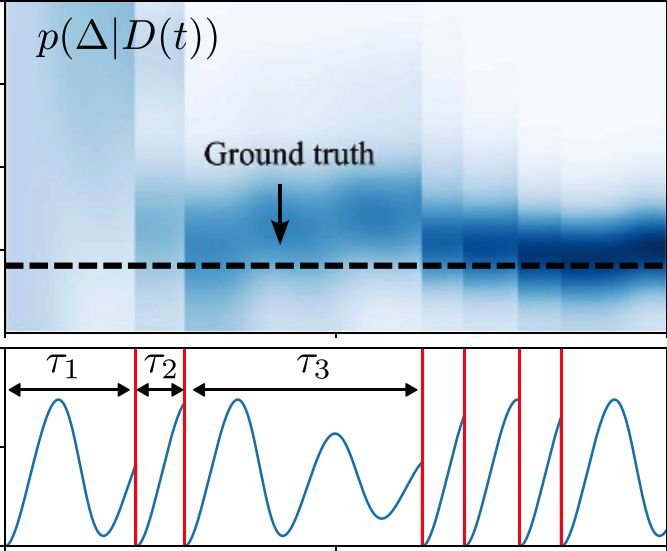
Abstract We present an inference method utilizing artificial neural networks for parameter estimation of a quantum probe monitored through a single continuous measurement. Unlike existing approaches focusing on the diffusive signals generated by continuous weak measurements, our method harnesses quantum correlations in discrete photon-counting data characterized by quantum jumps. We benchmark the precision of this method against Bayesian inference, which is optimal in the sense of information retrieval. By using numerical experiments on a two-level quantum system, we demonstrate that our approach can achieve a similar optimal performance as Bayesian inference, while drastically reducing computational costs. Additionally, the method exhibits robustness against the presence of imperfections in both measurement and training data. This approach offers a promising and computationally efficient tool for quantum parameter estimation with photon-counting data, relevant for applications such as quantum sensing or quantum imaging, as well as robust calibration tasks in laboratory-based settings.
Phys. Rev. Research
Dissipative stabilization of maximal entanglement between nonidentical emitters via two-photon excitation
Alejandro Vivas-Viaña, Diego Martín-Cano, and Carlos Sánchez Muñoz
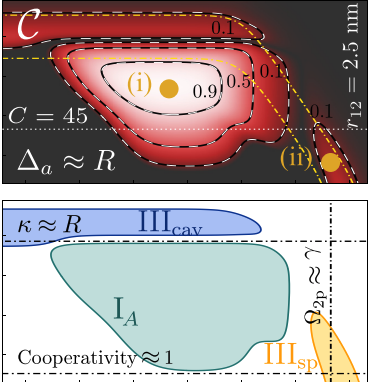
Two nonidentical quantum emitters, when placed within a cavity and coherently excited at the two-photon resonance, can reach stationary states of nearly maximal entanglement. In Vivas-Viaña, Martín-Cano, and Sánchez Muñoz [], we introduce a frequency-resolved Purcell effect stabilizing entangled W states among strongly interacting quantum emitters embedded in a cavity. Here we delve deeper into a specific configuration with a particularly rich phenomenology: two interacting quantum emitters under coherent excitation at the two-photon resonance. This scenario yields two resonant cavity frequencies where the combination of two-photon driving and Purcell-enhanced decay stabilizes the system into the subradiant and superradiant states, respectively. By considering the case of nondegenerate emitters and exploring the parameter space of the system, we show that this mechanism is merely one among a complex family of phenomena that can generate both stationary and metastable entanglement when driving the emitters at the two-photon resonance. We provide a global perspective of this landscape of mechanisms and contribute analytical characterizations and insights into these phenomena, establishing connections with previous reports in the literature and discussing how some of these effects can be optically detected. Published by the American Physical Society2024
Phys. Rev. Lett.
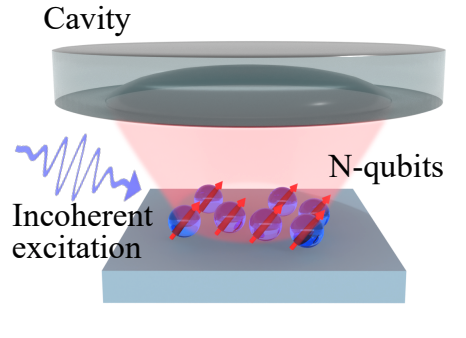
Frequency-Resolved Purcell Effect for the Dissipative Generation of Steady-State Entanglement
Alejandro Vivas-Viaña, Diego Martín-Cano, and Carlos Sánchez Muñoz
Recently, several studies involving open quantum systems which possess a strong symmetry have observed that every individual trajectory in the Monte Carlo unravelling of the master equation will dynamically select a specific symmetry sector to ‘freeze’ into in the long-time limit. This phenomenon has been termed ‘dissipative freezing’, and in this paper we argue, by presenting several simple mathematical perspectives on the problem, that it is a general consequence of the presence of a strong symmetry in an open system with only a few exceptions. Using a number of example systems we illustrate these arguments, uncovering an explicit relationship between the spectral properties of the Liouvillian in off-diagonal symmetry sectors and the time it takes for freezing to occur. In the limiting case that eigenmodes with purely imaginary eigenvalues are manifest in these sectors, freezing fails to occur. Such modes indicate the preservation of information and coherences between symmetry sectors of the system and can lead to phenomena such as non-stationarity and synchronisation. The absence of freezing at the level of a single quantum trajectory provides a simple, computationally efficient way of identifying these traceless modes.
J. Phys. Soc. Jpn.
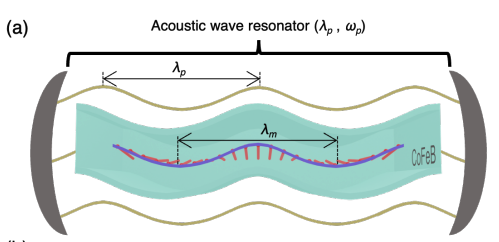
Nonlinear Acoustic Spin Pumping Caused by Temperature-Dependent Frequency Shifts of Surface Acoustic Waves
Yunyoung Hwang, Jorge Puebla, Kouta Kondou, Carlos Sánchez Muñoz, and Yoshichika Otani
Abstract In nature, instances of synchronisation abound across a diverse range of environments. In the quantum regime, however, synchronisation is typically observed by identifying an appropriate parameter regime in a specific system. In this work we show that this need not be the case, identifying conditions which, when satisfied, guarantee that the individual constituents of a generic open quantum system will undergo completely synchronous limit cycles which are, to first order, robust to symmetry-breaking perturbations. We then describe how these conditions can be satisfied by the interplay between several elements: interactions, local dephasing and the presence of a strong dynamical symmetry—an operator which guarantees long-time non-stationary dynamics. These elements cause the formation of entanglement and off-diagonal long-range order which drive the synchronised response of the system. To illustrate these ideas we present two central examples: a chain of quadratically dephased spin-1s and the many-body charge-dephased Hubbard model. In both cases perfect phase-locking occurs throughout the system, regardless of the specific microscopic parameters or initial states. Furthermore, when these systems are perturbed, their nonlinear responses elicit long-lived signatures of both phase and frequency-locking.
Phys. Rev. Lett.
Photon Correlation Spectroscopy as a Witness for Quantum Coherence
Topological order and thermal equilibrium in polariton condensates
Davide Caputo, Dario Ballarini, Galbadrakh Dagvadorj, Carlos Sánchez Muñoz, Milena De Giorgi, Lorenzo Dominici, Kenneth West, Loren N. Pfeiffer, Giuseppe Gigli, Fabrice P. Laussy, Marzena H. Szymańska, and Daniele Sanvitto
First observation of the quantized exciton-polariton field and effect of interactions on a single polariton
Álvaro Cuevas, Juan Camilo López Carreño, Blanca Silva, Milena De Giorgi, Daniel G. Suárez-Forero, Carlos Sánchez Muñoz, Antonio Fieramosca, Filippo Cardano, Lorenzo Marrucci, Vittorianna Tasco, Giorgio Biasiol, Elena Valle, Lorenzo Dominici, Dario Ballarini, Giuseppe Gigli, Paolo Mataloni, Fabrice P. Laussy, Fabio Sciarrino, and Daniele Sanvitto
AbstractRecent technological developments have made it increasingly easy to access the non-perturbative regimes of cavity quantum electrodynamics known as ultrastrong or deep strong coupling, where the light–matter coupling becomes comparable to the bare modal frequencies. In this work, we address the adequacy of the broadly used single-mode cavity approximation to describe such regimes. We demonstrate that, in the non-perturbative light–matter coupling regimes, the single-mode models become unphysical, allowing for superluminal signalling. Moreover, considering the specific example of the quantum Rabi model, we show that the multi-mode description of the electromagnetic field, necessary to account for light propagation at finite speed, yields physical observables that differ radically from their single-mode counterparts already for moderate values of the coupling. Our multi-mode analysis also reveals phenomena of fundamental interest on the dynamics of the intracavity electric field, where a free photonic wavefront and a bound state of virtual photons are shown to coexist.
Optica
Filtering multiphoton emission from state-of-the-art cavity quantum electrodynamics
Carlos Sánchez Muñoz, Fabrice P. Laussy, Elena del Valle, Carlos Tejedor, and Alejandro González-Tudela
Dario Ballarini, Davide Caputo, Carlos Sánchez Muñoz, Milena De Giorgi, Lorenzo Dominici, Marzena H. Szymańska, Kenneth West, Loren N. Pfeiffer, Giuseppe Gigli, Fabrice P. Laussy, and Daniele Sanvitto
AbstractThe Hanbury Brown–Twiss effect is one of the celebrated phenomenologies of modern physics that accommodates equally well classical (interferences of waves) and quantum (correlations between indistinguishable particles) interpretations. The effect was discovered in the late thirties with a basic observation of Hanbury Brown that radio-pulses from two distinct antennas generate signals on the oscilloscope that wiggle similarly to the naked eye. When Hanbury Brown and his mathematician colleague Twiss took the obvious step to propose bringing the effect in the optical range, they met with considerable opposition as single-photon interferences were deemed impossible. The Hanbury Brown–Twiss effect is nowadays universally accepted and, being so fundamental, embodies many subtleties of our understanding of the wave/particle dual nature of light. Thanks to a novel experimental technique, we report here a generalized version of the Hanbury Brown–Twiss effect to include the frequency of the detected light, or, from the particle point of view, the energy of the detected photons. Our source of light is a polariton condensate, that allows high-resolution filtering of a spectrally broad source with a high degree of coherence. In addition to the known tendencies of indistinguishable photons to arrive together on the detector, we find that photons of different colors present the opposite characteristic of avoiding each others. We postulate that fermions can be similarly brought to exhibit positive (boson-like) correlations by frequency filtering.
2015
Phys. Rev. Lett.
Coherent Generation of Nonclassical Light on Chip via Detuned Photon Blockade
Kai Müller, Armand Rundquist, Kevin A. Fischer, Tomas Sarmiento, Konstantinos G. Lagoudakis, Yousif A. Kelaita, Carlos Sánchez Muñoz, Elena Valle, Fabrice P. Laussy, and Jelena Vučković
Bichromatic dressing of a quantum dot detected by a remote second quantum dot
M. Maragkou, C. Sánchez-Muñoz, S. Lazić, E. Chernysheva, H. P. Meulen, A. González-Tudela, C. Tejedor, L. J. Martínez, I. Prieto, P. A. Postigo, and J. M. Calleja
 Deterministic single-photon source over the terahertz regime2025
 Quantum metrology through spectral measurements in quantum optics2025



 Quantum amplification and simulation of strong and ultrastrong coupling of light and matterPhysics Reports, 2024
 Strongly Coupled Spin Waves and Surface Acoustic Waves at Room TemperaturePhysical Review Letters, 2024
 Frequency-Resolved Purcell Effect for the Dissipative Generation of Steady-State EntanglementPhysical Review Letters, 2024




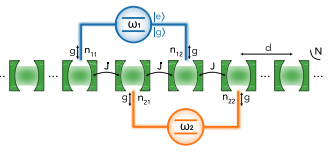 Interaction between giant atoms in a one-dimensional structured environmentPhysical Review A, 2023
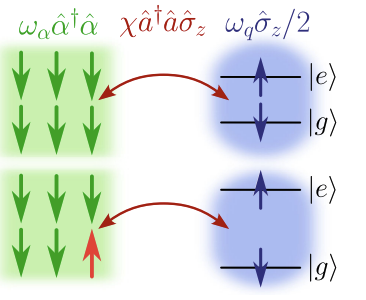 Resolving Nonclassical Magnon Composition of a Magnetic Ground State via a QubitPhysical Review Letters, 2023
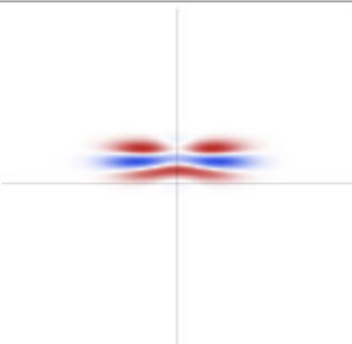 Nonlinear Interferometry for Quantum-Enhanced Measurements of Multiphoton AbsorptionPhysical Review Letters, 2023


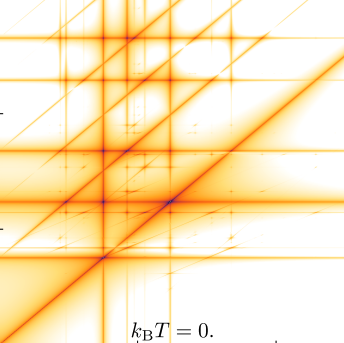 Spontaneous Scattering of Raman Photons from Cavity-QED Systems in the Ultrastrong Coupling RegimePhysical Review Letters, 2022


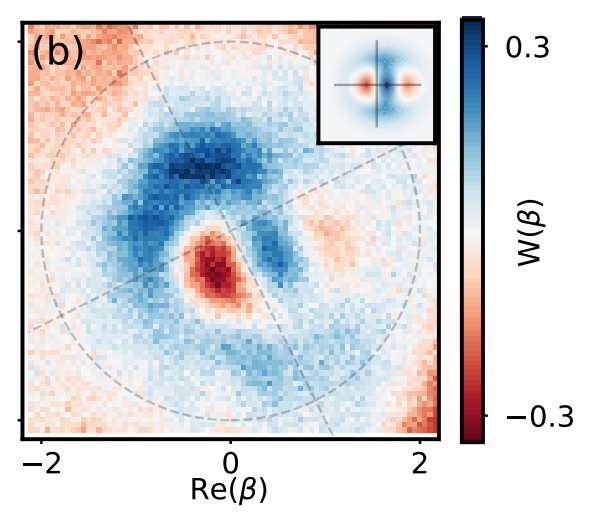 Quantum State Tomography with Conditional Generative Adversarial NetworksPhysical Review Letters, 2021


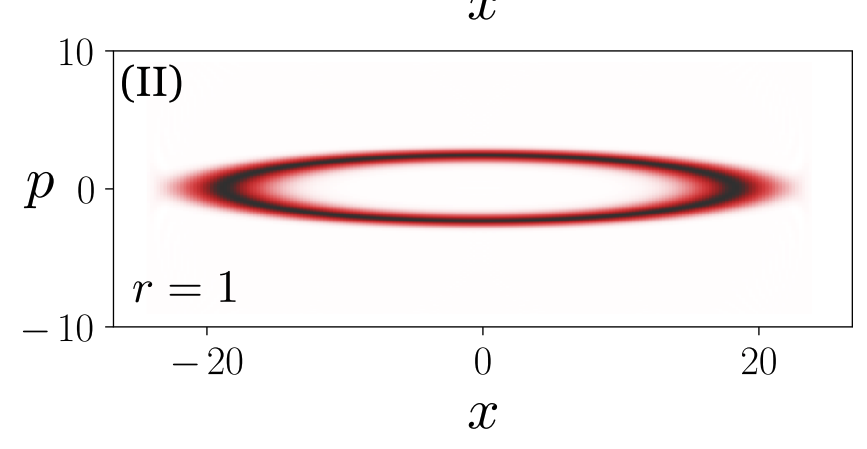


 Symmetries and conservation laws in quantum trajectories: Dissipative freezingPhysical Review A, 2019
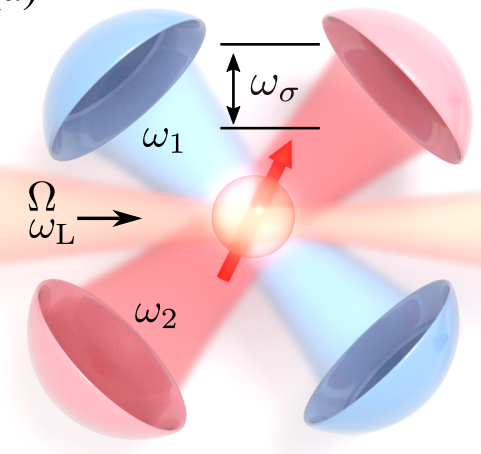 Simulating ultrastrong-coupling processes breaking parity conservation in Jaynes-Cummings systemsPhysical Review A, 2019


 Filtering multiphoton emission from state-of-the-art cavity quantum electrodynamicsOptica, 2018
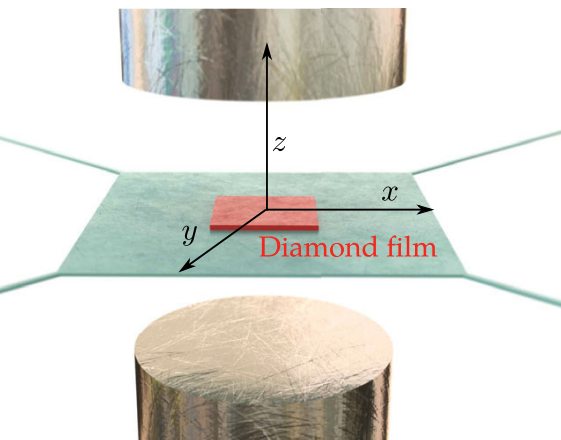 Hybrid Systems for the Generation of Nonclassical Mechanical States via Quadratic InteractionsPhysical Review Letters, 2018